Report writing requires you to tailor your language to your audience.
Who is your audience, and how can you tell?
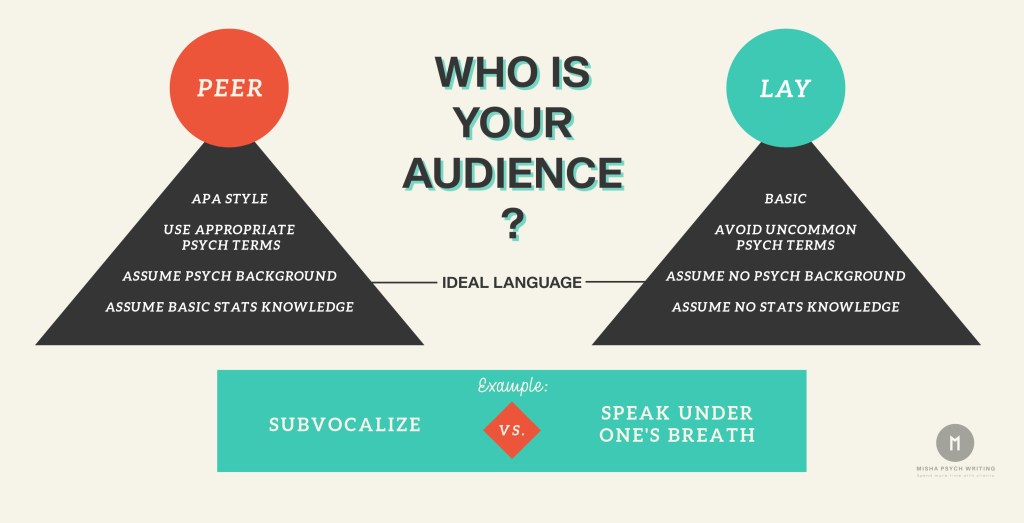
You likely have a peer audience if you are writing reports that will be read by fellow clinicians, psychology students, researchers, or journals/literature.
If this is your audience, your ideal language may follow APA Style and may require you to utilize appropriate psychology terms for the type of report you are writing. You can assume that your readers have a psychology background and at least a basic understanding of statistics.
You likely have a lay audience if you are writing reports that will be read by clients, clients’ parents/guardians/representatives, or school districts.
If this is your audience, your ideal language ought to be basic and may involve few psychology terms aside from those that are in common usage (e.g., depression, anxiety, psychotherapy). You cannot assume that your readers have a psychology background or understand psychological terms. Likewise, you cannot assume that your readers have even a rudimentary understanding of statistics.
Ideally, your writing should present your results as clearly as possible for your target reader.
For example:
subvocalizing vs. speaking under one’s breath
If you cannot decide on phrasing, ask yourself questions like these:
Which description is likely to make the most sense to the person reading your report?
Which description is likely to be the most useful to your target reader?
Agree/disagree? Have suggestions of your own? Let us know!

 Misha Psych Writing
Leave a comment