
When writing behavioral observations, it can be tempting to interpret or explain what you see in front of you. A client may look nervous, sad, or angry, and as psychology writing tends to focus on emotions, it often seems most useful to convey meaning using adjectives and “feelings” words.
Unfortunately, that can sometimes cause important nuance and context to be left out.
In writing, we often refer to “show vs. tell” as a rule of thumb, but it might be better stated as “describe vs. explain.” In behavioral observations, descriptions of behaviors often convey more useful, accurate information than a clinician’s interpretations.
Why?
Behaviors can have multiple causes and meanings, many of which cannot be discerned by observers.
Why might that be important in report writing?
As an example, let’s say a patient is trembling during a testing session.
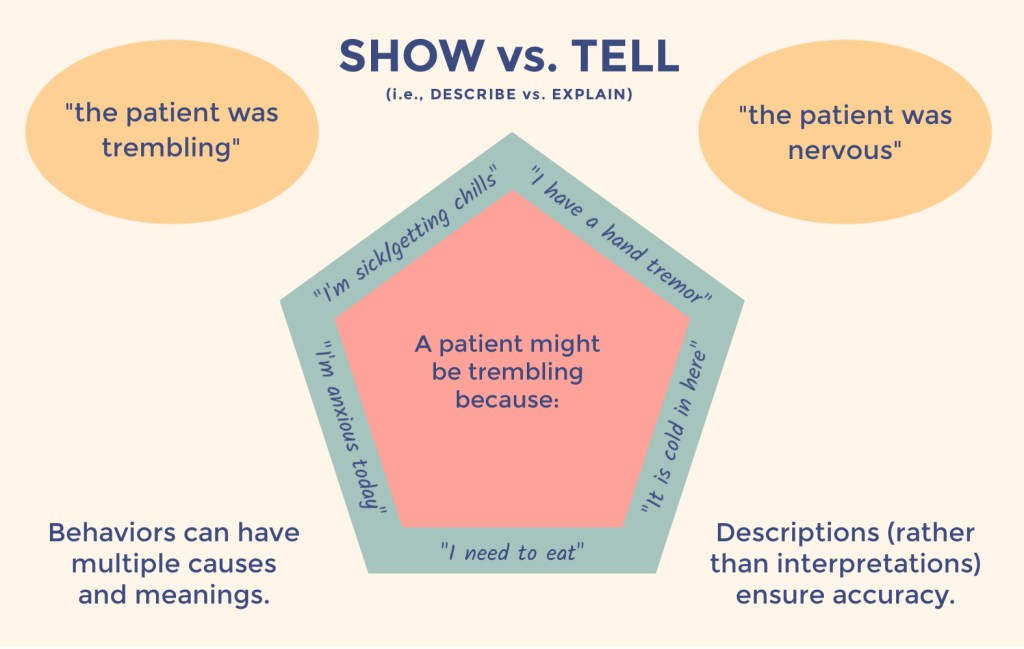
You might write “the patient was trembling” (show) or “the patient was nervous” (tell).
Either or both statements might be accurate. But because trembling can occur for multiple reasons, it may be incorrect to assume that it is due to anxiety.
A patient may be trembling because:
“I’m sick and getting chills” (go home!)
“I’m anxious today”
“I have a hand tremor”
“It is cold in here”
“I need to eat”
Anxiety might be the cause, but the reason may also be a combination of the explanations above or something different altogether.
Sometimes, patients may even be unaware of the reason for a behavior or may not realize they are exhibiting it.
When in doubt, ask a client about the behavior in front of you, and note their answer. However, to ensure accuracy, always include the description of the behaviors.
In short, describing behaviors rather than attempting to interpret them ensures that your report contains accurate details rather than assumptions.
Examples:
Patient A was cooperative and wanted to ask questions quickly. They seemed anxious while speaking, though they continued to participate despite anxiety. The patient tried their best to work quickly throughout the session.
vs.
Patient A was cooperative and responded rapidly to questions. Their hands shook during session, and when asked, the patient stated that they have had a mild hand tremor since childhood. The patient continued to respond at a similar pace throughout the session.
What are your thoughts? Do you agree? Disagree? Let me know!


Leave a Reply